|

CORP PROFILE
LENTOR CLUSTER
RIVER VALLEY /HAVELOCK CLUSTER
LOYANG / FLORA DRIVE CLUSTER
GLS
MARKETS
DEVT
MKTG
AGENCIES
SG GOV
CEA
SOP
ML-FT
MGT
TID
DEVELOPERS
BUILDER
NEWS
SINGAPORE LISTINGS
PDPA
TID SITE VISIT
| | TID SITE VISIT

Greetings from all of us  Thanks for Visiting Thanks for Visiting

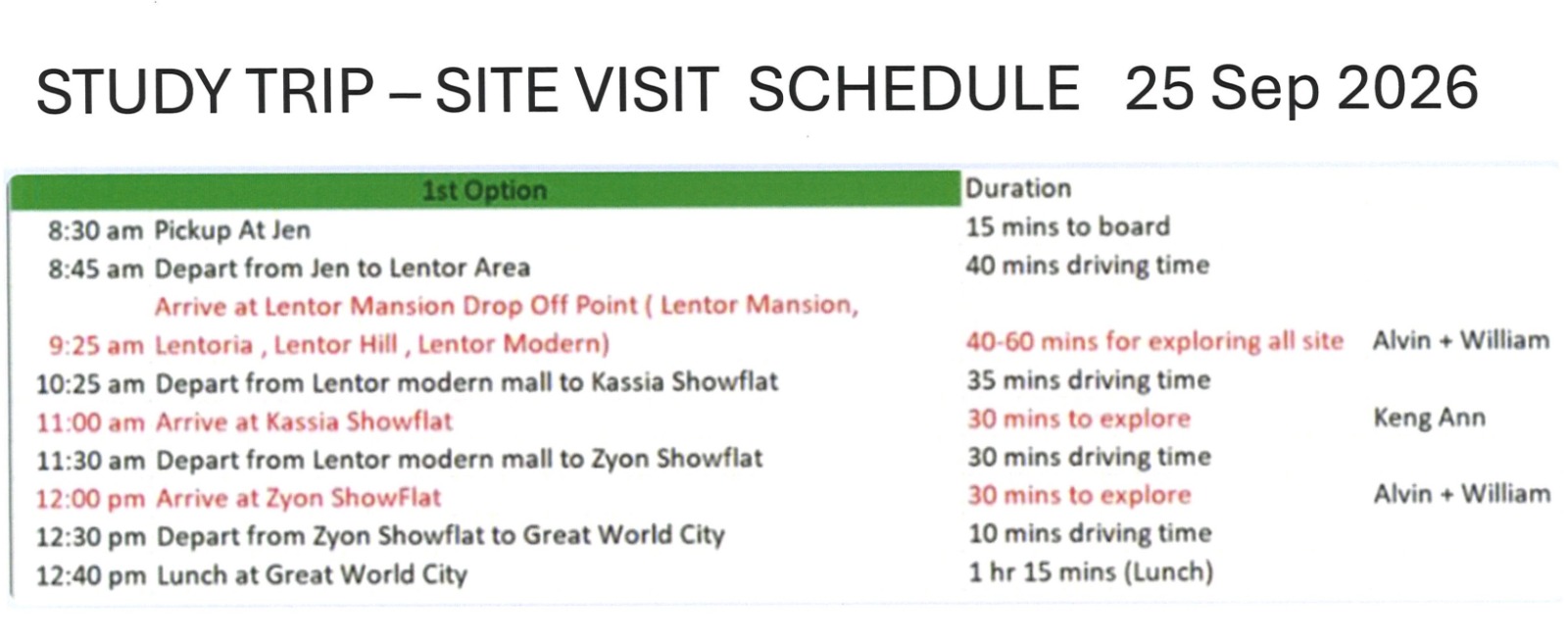
Study Trip Schedule
 |
|
SINGAPORE STORY – THE NEXT GENERATION
Singapore as a city-state-country with no sovereign hinterland- faces a
unique geographical constrains on land, resources and nature.
We have to
pack so much on this little island with precise integrated national
infrastructure plan- above ground and under ground to meet the long
term needs for transport, green plans, digital connectivity, water ,
energy and public spaces , parks , education, social and housing and
sustainable growth over time. Building people cities to enable
communities to thrive and evolve over time.
Just on this little island,
we have one of the largest containers port in the world, we housed 17
reservoirs and many catchment forests and the 18th at Long
Island coming up and is a first step to combat climatic change due to
rising sea levels.
We are also reinventing our tourist destinations and
attractions to enable every visitor to Singapore to have a memorable
experience.
The
future story will be written differently as we face an aging Population,
lowering Total Fertitlity Rate,
Disrupting technologies from Internet of
things and virtual reality VR store now into generative AI to agentic
AI and technological driven on demand and social – push platforms and e
commerce driven by algorithm.
We face rapid changes and our
transformation and realignment must be fast enough. These trends and
disruptions are all converging on Singapore.
With
the Long Term plan
to take all these evolving trends and projecting 50 years ahead
and a Master Plan that reviews every
5 years,
we
continually refined the needs of the day to ensure their relevance, and
is driven by the whole of government and respective agencies- where
assumptions, feedback and projections and strategies are
adjusted from time to time.
We need to re-imagine and go beyond
our constraints. We have to re-imagine the city and
bring Nature into the City- City in Nature.
Going
forward, Singapore has several long term development project such as T5
extensions, Jurong Island, Long Island in east coast, Great Southern
Waterfront including Marina South in south coast, Turf
City, Punggol Digital District, Paya Lebar Development,
... Cross Island Line, N-S corridor highways as well as RTS to Johore Baru.
We are
also creating more land our of the seas in our western and southern
islands and improving the connectivity eg tunnels to Pulau Tekong.
Future
mega reclamation projects were announced recently and future nuclear
energy approaches are also being studied.
These developments, their purpose, phasing and will
contribute to different strategic purposes and the future plans
Housing is at the core of planning as 80% in HDB and 90% owned their
flats- and affordable housing amidst rising cost of housing is one
of the key concerns. We now have Prime and Plus HDB flats with
special conditions.
Residents are also moving up the ladder of demands for smart
architecture, smart estate management and monitoring of all resources,
waste and with sensors and big data analytics to drive efficiency ,
smart enabled homes for living
Singapore’s next-generation plans are all about squeezing value
from scarce land while boosting resilience, connectivity and high-value
jobs.
What
these projects add up to — strategic picture
-
Land & housing supply:
redevelopment (GSW, Paya Lebar) + reclamation (Long Island) expand
scarce developable area and free up growth capacity near the city.
URA Draft Master Plan+1
-
Economic upgrading:
industry clusters (Jurong Island energy/chemicals; Punggol Digital
District for tech) push Singapore up the value chain and create
higher-skill jobs.
Economic Development Board+1
-
Resilience & water security:
“Long Island” reservoir + coastal buffers and industrial resilience
works (Jurong Island utilities, desalination) strengthen Singapore
against climate threats.
Urban Redevelopment Authority+1
-
Connectivity & modal shift:
major rail projects (CRL, RTS) improve cross-island and cross-border
connectivity, making transit viable for more trips and supporting
denser, transit-oriented developments.
Land Transport Authority+1
Practical expectations (what to look for, and when)
-
Staged, long-horizon roll-out.
Many of these are multi-decade programmes. Expect infrastructure and
early development phases through the late-2020s and major new
neighbourhoods and reclamation works into the 2030s. (Examples: CRL
initial links by the late-2020s; Paya Lebar relocation from the
2030s; RTS target c. 2026–2027).
Land Transport Authority+2URA Draft Master Plan+2
-
New neighbourhoods first, then amenities.
URA/JTC project phasing usually starts with infrastructure and basic
housing parcels, then commercial, parks and finer urban design.
Expect staged BTO launches and private launches in the GSW and Paya
Lebar precincts.
URA Draft Master Plan
-
Construction & short-term disruption.
Large reclamation and rail works will mean construction activity,
temporary traffic changes and engineered shoreworks — but these are
phased to limit citywide disruption.
Urban Redevelopment Authority+1
-
Opportunities:
development sites, new jobs (tech, cyber, energy), property and
business investment near new interchanges, and more
leisure/waterfront amenities in the south.
JTC+1
Quick
timeline summary (high-level)
-
Now → late-2020s:
CRL Phase 1 works and Punggol Digital District roll-out; Jurong
Island terminal/utility upgrades; planning & early actions for GSW
(Keppel site).
Land Transport Authority+2JTC+2
-
Mid-2020s → 2030s:
RTS targeted opening (c.2026–27), more GSW housing rollouts,
continued reclamation planning, industrial decarbonisation
programmes on Jurong Island.
Land Transport Authority+1
-
2030s and beyond:
Paya Lebar Air Base relocation enabling major mixed-use
redevelopment; Long Island reclamation/reservoir implementation as
climate adaptation needs and timing dictate.
URA Draft Master Plan+1
Below
I’ll summarize each project you named (purpose, phasing/what’s happening
now, strategic role) and finish with short “what to expect” takeaways
and timing notes. I’ve used official planning and agency sources for the
key facts.
Greater Southern Waterfront (including Marina South / Keppel area)
The Turf City Transformation
Paya
Lebar Airport
Marina Bay Sands – IR2
Marina Square – redevelopment
SENTOSA
Cross
island Line
RTS
– Johor
Punggol Digital District
N parks and Sustainability Journal
Jurong
island
Airport T5
Future
land Reclamation
|
|
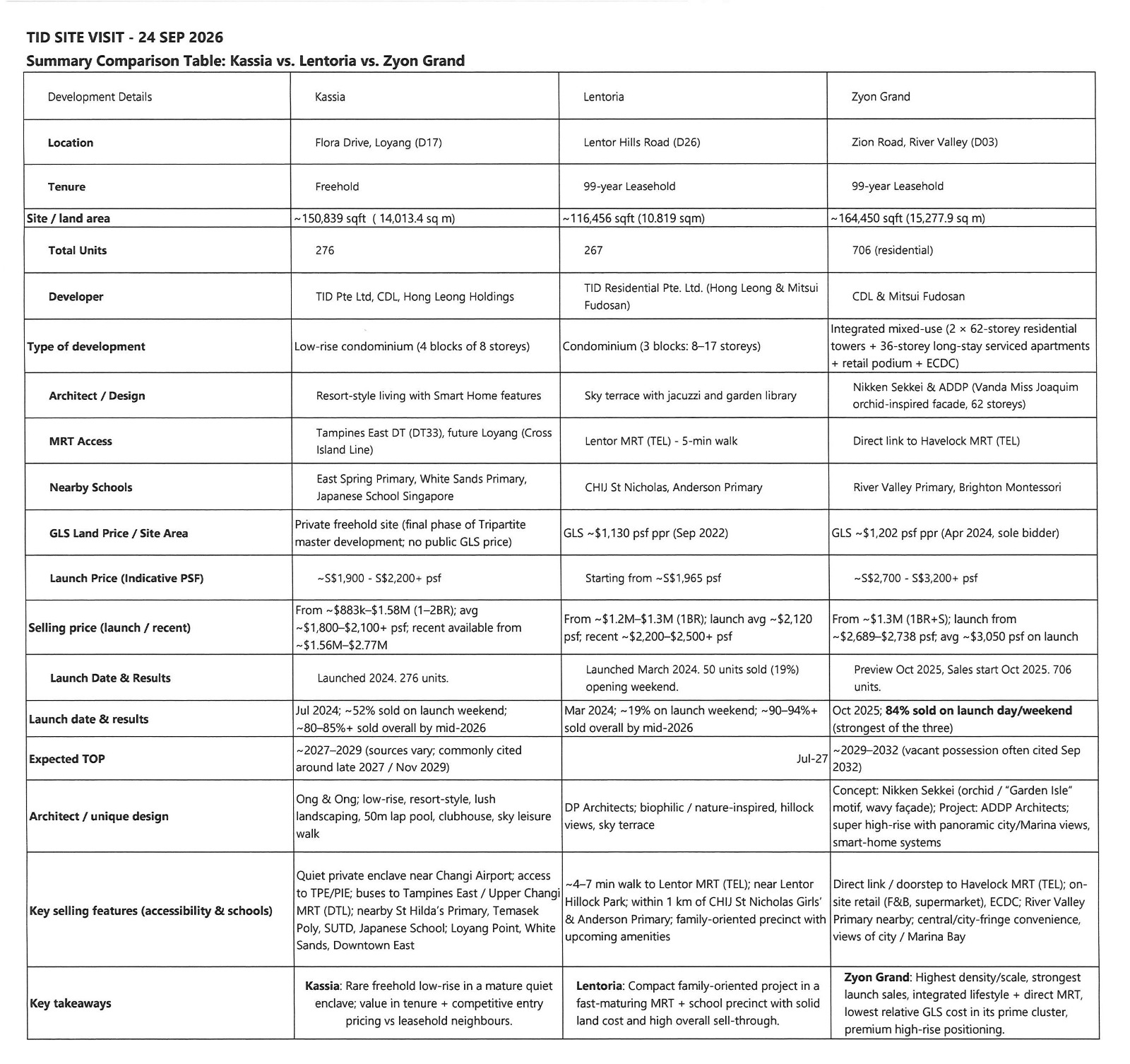
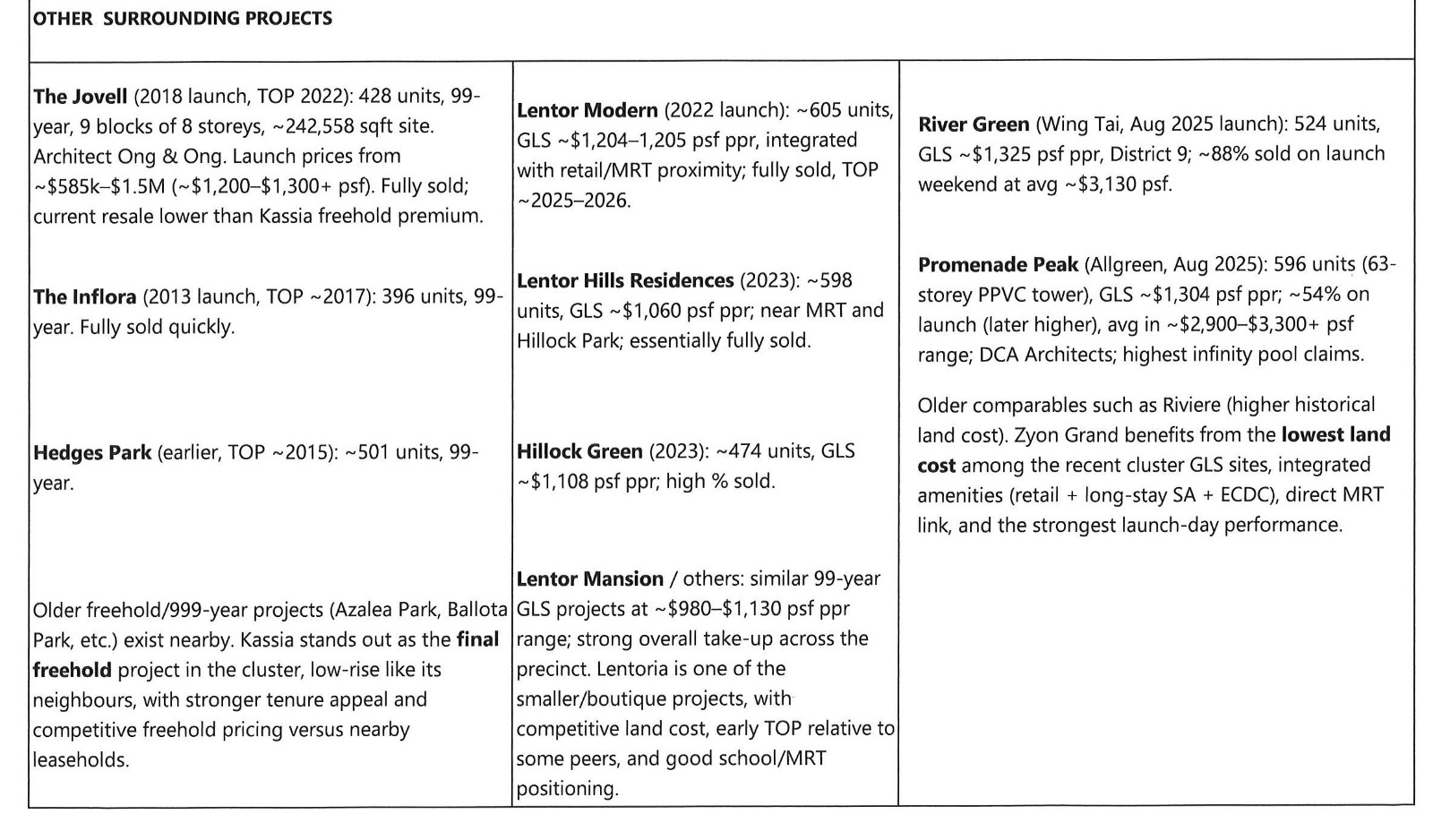
Projects
|
|
Cluster Analysis
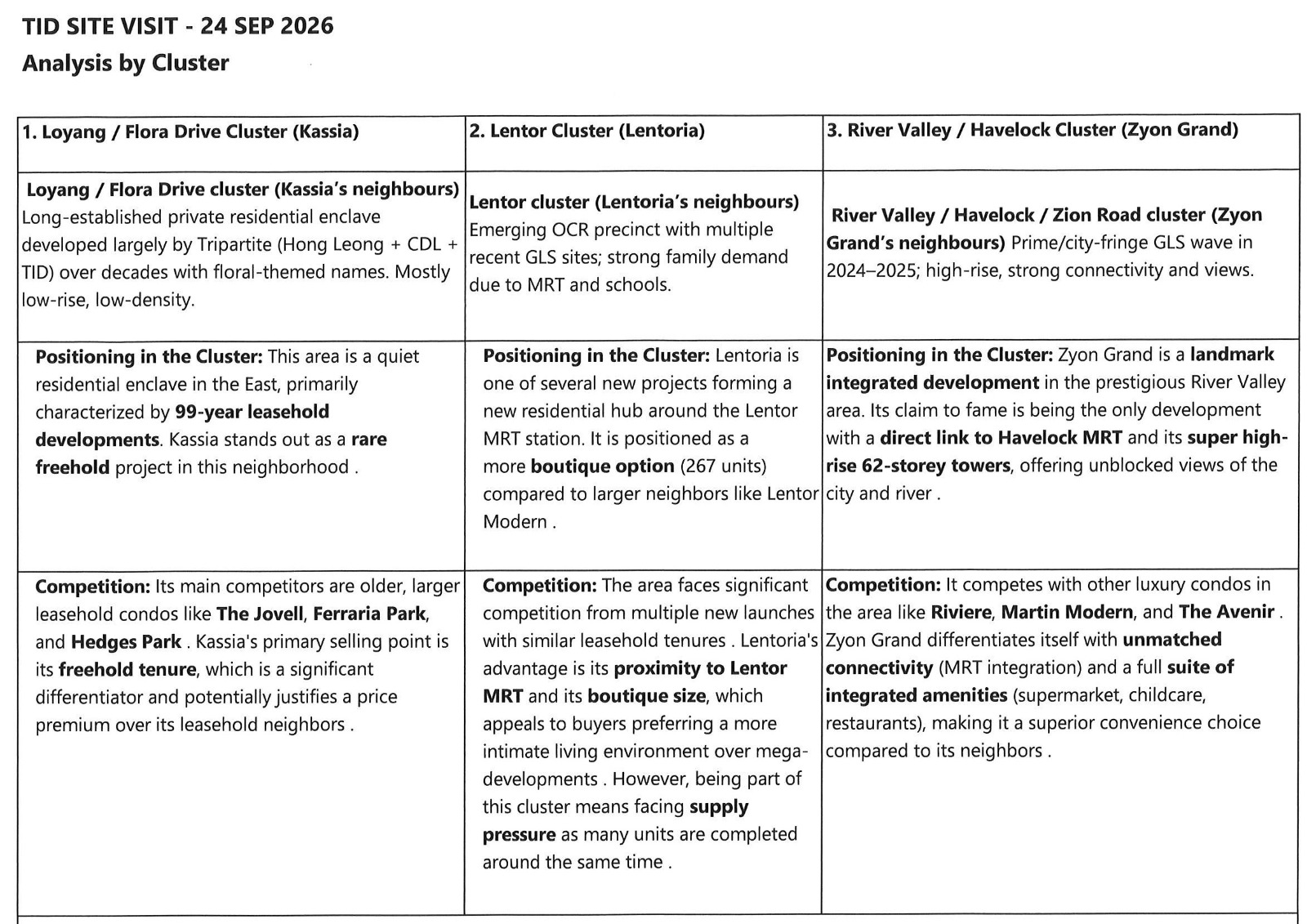
Analysis by Cluster
1.
Loyang / Flora Drive Cluster (Kassia)
-
Positioning in
the Cluster: This
area is a quiet residential enclave in the East, primarily
characterized by 99-year leasehold developments. Kassia
stands out as a rare freehold project in this neighborhood .
-
Competition: Its
main competitors are older, larger leasehold condos like The
Jovell, Ferraria Park, and Hedges Park . Kassia's
primary selling point is its freehold tenure, which is a
significant differentiator and potentially justifies a price premium
over its leasehold neighbors .
2.
Lentor Cluster (Lentoria)
-
Positioning in
the Cluster: Lentoria
is one of several new projects forming a new residential hub around
the Lentor MRT station. It is positioned as a more boutique
option (267 units) compared to larger neighbors like Lentor
Modern .
-
Competition: The
area faces significant competition from multiple new launches with
similar leasehold tenures . Lentoria's advantage is its proximity
to Lentor MRT and its boutique size, which appeals to
buyers preferring a more intimate living environment over
mega-developments . However, being part of this cluster means
facing supply pressure as many units are completed around the
same time .
3.
River Valley / Havelock Cluster (Zyon Grand)
-
Positioning in
the Cluster: Zyon
Grand is a landmark integrated development in the prestigious
River Valley area. Its claim to fame is being the only development
with a direct link to Havelock MRT and its super high-rise
62-storey towers, offering unblocked views of the city and
river .
-
Competition: It
competes with other luxury condos in the area like Riviere, Martin
Modern, and The Avenir . Zyon Grand differentiates itself
with unmatched connectivity (MRT integration) and a full suite
of integrated amenities (supermarket, childcare, restaurants),
making it a superior convenience choice compared to its neighbors .
| Lentoria
THE BROCHURE - TAKING LUSH
LIVING TO NEW HEIGHTS
Comparison
of key Lentor cluster projects (Hillock Green, Lentor Mansion,
Lentor Hills Residences, Lentor Modern).
Data is compiled
from developer materials, EdgeProp, property sites, and market
reports as of 2025–2026. Figures are approximate/indicative and
can vary by source or unit; always verify with the latest
official info.
All are 99-year
leasehold in District 26.
|
Aspect |
Hillock Green |
Lentor
Mansion |
Lentor Hills
Residences |
Lentor Modern |
|
Developer |
Lentor Central Developments Pte Ltd
(JV: Forsea Holdings / China
Communications Construction,
Soilbuild Group, United Engineers /
Yanlord) |
GuocoLand + Hong Leong Holdings (Lentor
Mansion Pte Ltd) |
Lentor Hills Development Pte Ltd
(JV: GuocoLand, Hong Leong Holdings,
TID / Mitsui Fudosan) |
GuocoLand (GLL D Pte Ltd) |
|
Land area |
~13,444 sqm / ~144,700–144,714 sqft |
~21,867 sqm / ~235,370–235,373 sqft
(largest among the four) |
~17,137 sqm / ~184,460–184,462 sqft |
~17,280 sqm / ~186,000 sqft |
|
Development mix |
Pure residential;
474 units
(1–4BR) across
3 blocks
of 23 storeys |
Pure residential (with childcare);
533 units
(2–5BR, no 1BR) across
6 blocks
(mix of 8- & 16-storey) |
Pure residential (with childcare);
598 units
(1–4BR + dual-key) across
5 blocks
(8–23 storeys) |
Integrated mixed-use: 605
residential units (1–4BR) in
3 ×
25-storey towers above
~90,000–96,000 sqft retail mall
(supermarket, F&B, childcare) +
direct MRT link |
|
Land price (psf ppr) |
~$1,108 |
~$985 (lowest of the four; sole bid) |
~$1,060 |
~$1,204 (highest) |
|
Launch price & when |
Nov 2023; avg
~$2,100–$2,108 psf (range
~$1,837–$2,513) |
Mar 2024; avg
~$2,104–$2,257 psf (range
~$2,082–$2,478; highest average
among many Lentor projects) |
Jul 2023; avg
~$2,080–$2,100 psf |
Sep 2022; avg
~$2,102–$2,107 psf (range
~$1,856–$2,538); first project in
the cluster |
|
Walk to Lentor MRT (TEL) |
~2–4 min / ~150–300 m (covered
walkway; opposite mall/MRT area) |
~5 min / ~370–400 m |
~3–5 min / ~200–300 m (sheltered
linkway) |
Direct / integrated (0–1 min; built
above/adjacent to station) |
|
Hugging Lentor Hillock /
Hillock Park |
Yes — adjacent / extensive frontage
to Hillock Park (nature-centric
positioning; one of the highest
points in the estate) |
No direct “hugging” (more
estate-style with own
greenery/forest trails); further
from the central hillock park |
Yes — borders / adjacent to Hillock
Park (northwest side) + linear park
connections; elevated site with
nature focus |
No — more urban/integrated with mall
& MRT; nearby green buffers but not
directly hugging the hillock park |
|
TOP date |
Est. Jan 2028 (some sources note
target as early as late 2026/2027) |
Est. Q2 / mid-to-late 2028 (e.g., 30
Jun 2028) |
Est. 2026–Dec 2028 (target ~Dec 2026
in some reports; contractual later) |
Achieved Aug 2025 (early vs
contractual ~mid-2026); first
completed in the cluster |
|
Maintenance fees (est.
monthly) |
1BR: ~$300; 2BR: ~$360; 3BR:
~$360–$420; 4BR: ~$420 (subject to
change; based on share value) |
2BR: ~$350–$420 + GST; 3BR: ~$420 +
GST; 4/5BR: ~$490 + GST (indicative) |
1BR: ~$290 + GST; 2/3BR: ~$347 + GST;
4BR/dual-key: ~$406 + GST
(indicative) |
1BR: ~$352 + GST; 2BR: ~$396 + GST;
3BR: ~$396–$484 + GST; 4BR: ~$484 +
GST |
Notes
- Land price is the GLS tender rate (psf
per plot ratio).
- Launch prices are averages/ranges at
launch; current transacted/resale PSF are higher (especially
post-TOP for Lentor Modern). GFA harmonisation rules
(post-Sep 2022 tenders) affect later projects’ quoted areas.
- MRT timings are approximate walking
times; covered/sheltered paths improve convenience for
Hillock Green, Lentor Hills Residences, and especially
Lentor Modern.
- Hillock Park is the central green
feature of the Lentor Hills estate masterplan; Hillock Green
and Lentor Hills Residences have the strongest direct
adjacency.
- Maintenance fees are developer estimates based on share
value and can change post-TOP under MCST management.
- Other nearby projects (e.g., Lentoria, Lentor Central
Residences) exist but were not requested.
Sources include
developer factsheets, EdgeProp, property portals, and market
analyses. For the most current balance units, exact prices, or
site visits, contact the respective sales teams.
|
Kassia
KASSIA - DREAM LIVE AND THRIVE
|
| Zyon Grand
ZYON GRAND BROCHURE - An
Address That Stands Above All
INSPIRED BY
VANDA MISS JOAQUIM
Singapore’s
national flower is the Vanda Miss Joaquim
(scientifically Papilionanthe Miss Joaquim), a hybrid
orchid.
It was chosen
on 15 April 1981 for its vibrant colours, hardiness, year-round
blooming, and resilience—qualities seen as reflecting the
Singapore spirit.
Singapore is the only country with a
hybrid as its national flower.
History of the Flower
Around the early
1890s, Agnes Joaquim (born Ashkhen Hovakimian)
successfully cross-bred two orchids commonly grown in Singapore
gardens: the Burmese Vanda teres (now Papilionanthe
teres) and the Malayan Vanda hookeriana (now
Papilionanthe hookeriana).
In 1893, Henry
Nicholas Ridley (first scientific director of the Singapore
Botanic Gardens) examined the plant, had it sketched and
preserved, and published a description in The Gardeners’
Chronicle. He explicitly credited her: “A few years ago
Miss Joaquim, a lady residing in Singapore, well known for her
success as a horticulturist, succeeded in crossing Vanda
Hookeriana… and V. teres…” This made it the first
registered plant hybrid from Singapore and one of the earliest
documented Vanda hybrids.
The orchid won first prize for the rarest
orchid at Singapore’s 1899 Flower Show. It later
gained commercial success in the cut-flower industry and was
used as a symbol by groups such as the Progressive Party (1947)
and the Malayan Orchid Society (1957). In 1981 it was selected
from 40 contenders (mostly orchids) as the national flower, with
the “Agnes” variety preferred.
A historical
controversy arose in later decades claiming it might have been a
natural hybrid that Joaquim merely discovered. In 2016 the
National Parks Board and National Heritage Board reviewed the
evidence (including Ridley’s contemporary accounts) and
officially confirmed Joaquim as the breeder.
Agnes Joaquim’s Early Life in Singapore
Agnes was born on
7 April 1854 in Singapore into a
prominent second-generation Armenian
family of Persian-Armenian descent. She was the
eldest daughter and second of 11 children of Parsick (Basil)
Joaquim, an Armenian merchant and commercial agent who arrived
from Madras around 1840 and co-founded the trading firm Stephens
& Joaquim, and Urelia (Urughlu) Zechariah, a Singapore-born
Armenian.
Her maternal
grandfather, Isaiah Zechariah, was one
of the founders of the Armenian Apostolic Church of St Gregory
the Illuminator (opened 1835, Singapore’s oldest surviving
church and a National Monument). The family were
active church members.
They initially
lived at 30 (or nearby) Hill Street near other Armenian families
and the church. By 1861 they moved to a large mansion,
Mount Narcis, on a substantial plot (with gardens and
ponds) at 2 Narcis Street off Tanjong Pagar Road. The street and
house were named after her eldest brother Nerses (Narcis). Her
father served on the Agri-Horticultural Society and Botanic
Gardens boards; her mother was a prize-winning gardener. Agnes
and several siblings also regularly won awards at flower shows
for flowers, vegetables, fruits, and other plants.
Agnes never
married. She was a skilled embroiderer and active in the
Armenian Church.
She was already ill with cancer when
her orchid won the 1899 prize and died on 2 July
1899 at age 45, just three months later.
Tomb and Monuments (Especially in/near Tanjong
Pagar)
- Tomb: Agnes was originally buried at
Bukit Timah Cemetery. When that site was later acquired, her
tombstone was moved to the grounds of the Armenian
Church on Hill Street. It stands in the church’s
Garden of Memories, often with pots of Vanda Miss
Joaquim nearby. The epitaph reads: “Let her own
works praise her.”
- Vanda Miss Joaquim Pavilion (Tanjong
Pagar): Opened 14 April 2002. This small garden and pavilion
mark the approximate site of the family’s former Mount
Narcis residence on the now-vanished Narcis Street (near
present-day Tanjong Pagar Plaza / Craig Road area), where
the orchid is believed to have been bred in the family
gardens.
- Vanda Miss Joaquim Park (Yan Kit Road,
Tanjong Pagar area): A short distance away; it commemorates
both Agnes Joaquim and the national flower.
Other recognition
includes her 2015 induction into the Singapore Women’s Hall of
Fame (as the first woman in the world to breed a hybrid orchid)
and various place names (e.g., Vanda Road, Vanda Crescent). The
flower appears on currency, stamps, and in Singapore Airlines’
signature scent.
Her story highlights both Singapore’s
early horticultural history and the contributions of its
Armenian community.
|
|
|